
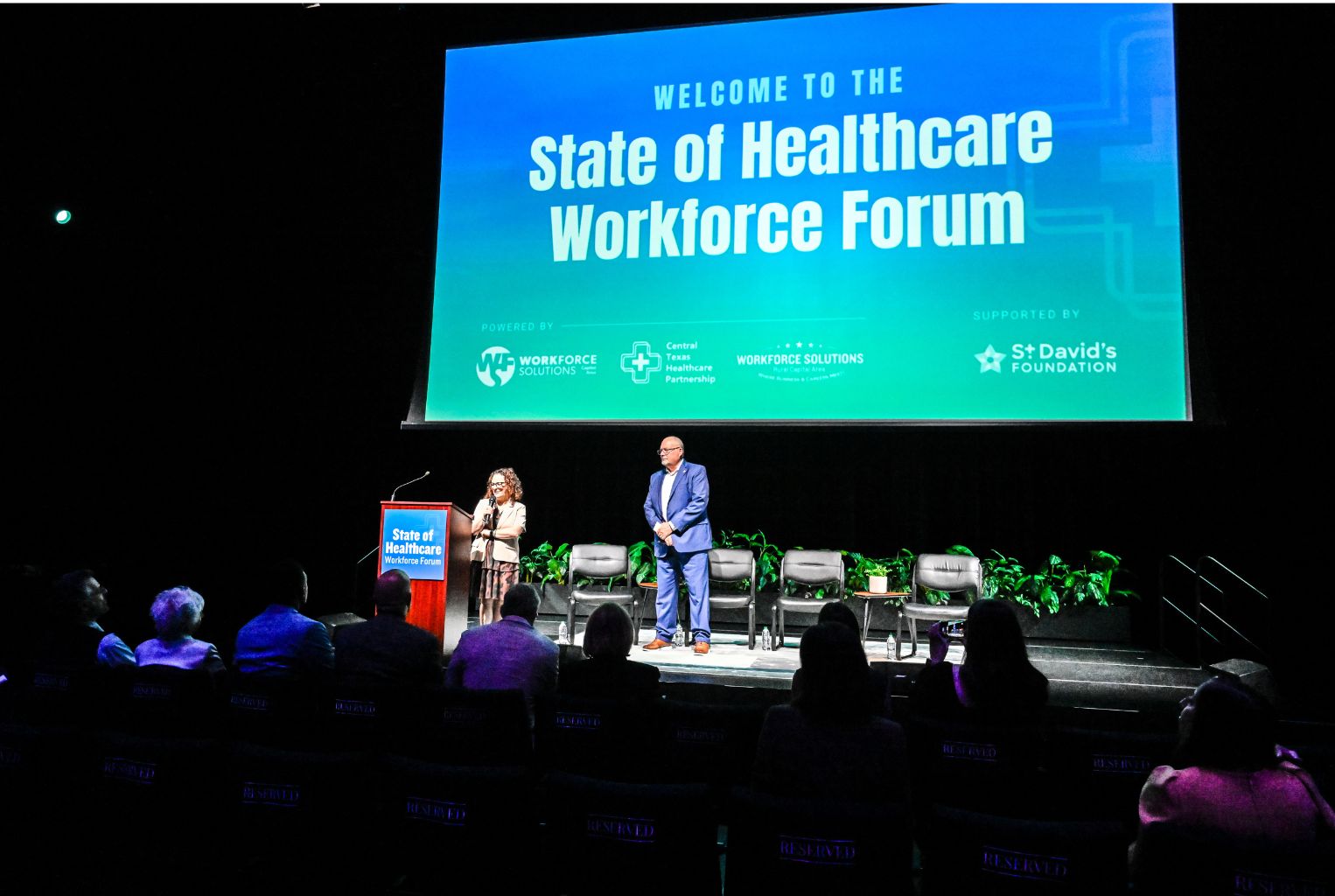
Central Texas’ healthcare workforce continues to grow, but so does the challenge of preparing enough people to meet the region’s needs.
At the second annual State of Healthcare Workforce Forum, Workforce Solutions Capital Area, Workforce Solutions Rural Capital Area, and St. David’s Foundation brought together healthcare employers, educators, workforce leaders, funders and community partners to take stock of the progress of the Central Texas Healthcare Partnership and focus on what comes next.
From state policy and artificial intelligence to education capacity, career pathways and student supports, speakers returned throughout the morning to a common challenge: Central Texas has strong interest in healthcare careers and strategies that are already building the workforce. The opportunity now is to remove the barriers that keep those strategies from reaching more people.
A workforce challenge decades in the making
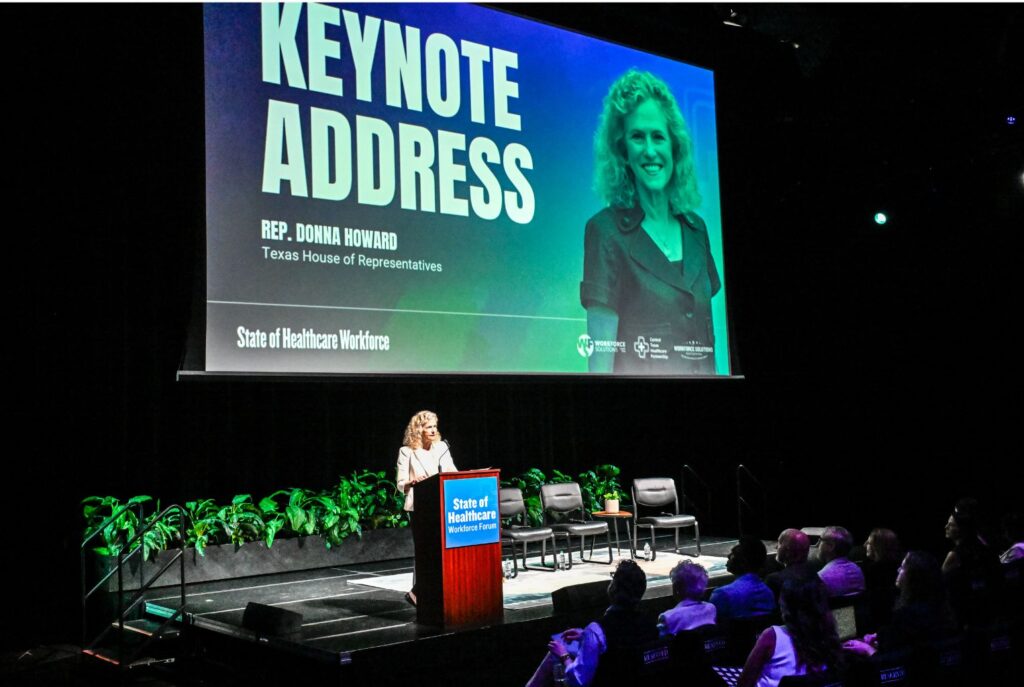
Texas State Rep. Donna Howard, a former critical care nurse, opened her keynote by reflecting on a healthcare workforce challenge she has been working on since shortly after joining the Legislature nearly 20 years ago.
At the time, state projections were already warning that demand for nurses could outpace supply. While Texas has since invested in loan forgiveness, nursing education and other workforce strategies, Howard said the underlying challenge remains — and now extends well beyond nursing to other healthcare occupations.
Recent legislative action has begun tackling some of the structural barriers behind that shortage. Howard highlighted new efforts to coordinate statewide healthcare workforce data, study regional systems for clinical placements, streamline nursing-school applications, support nurse preceptors and expand faculty loan repayment and nursing-education innovation grants.
But she also emphasized that education and workforce systems need to connect more intentionally.
Howard said she plans to continue pursuing policies that align high school and dual-credit healthcare programs with college requirements and industry-recognized credentials, helping students stack credentials instead of repeating coursework. She also called for stronger coordination between state agencies and local workforce boards.
And she pointed to Central Texas as evidence of what that coordination can accomplish.
Through efforts such as the Central Texas Healthcare Partnership, Howard said the region is demonstrating a model for addressing healthcare workforce shortages through collaboration among workforce organizations, employers and education partners.
Interest is strong. Capacity has to catch up.
The conversations that followed reinforced that Central Texas does not have a shortage of people interested in healthcare careers.
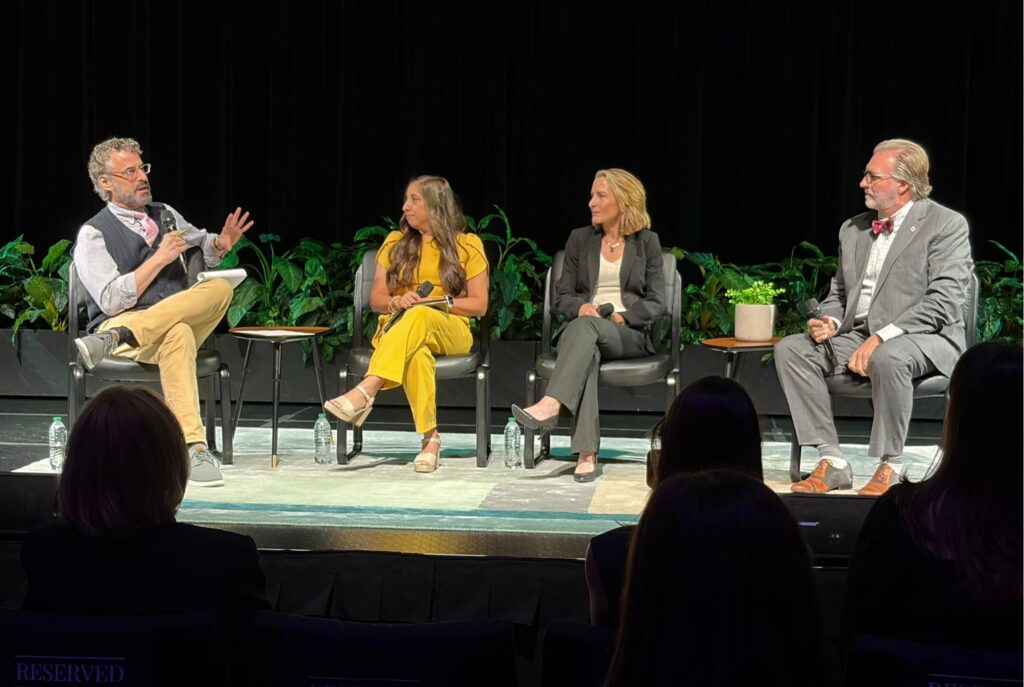
Austin Community College has approximately 9,000 students on pre-health science pathways competing for about 1,100 available program slots. Texas State University Round Rock reported approximately 600 nursing applicants for 150 slots.
The constraint is often what happens in between — particularly clinical placements, simulation space, faculty capacity and the cost of operating healthcare programs.
ACC Chancellor Dr. Russell Lowery-Hart said the college could potentially double healthcare-training capacity with sufficient clinical availability. Texas State Round Rock Vice President Dr. Julie Lessiter similarly pointed to simulation labs and clinical rotations as major constraints on expanding nursing enrollment.
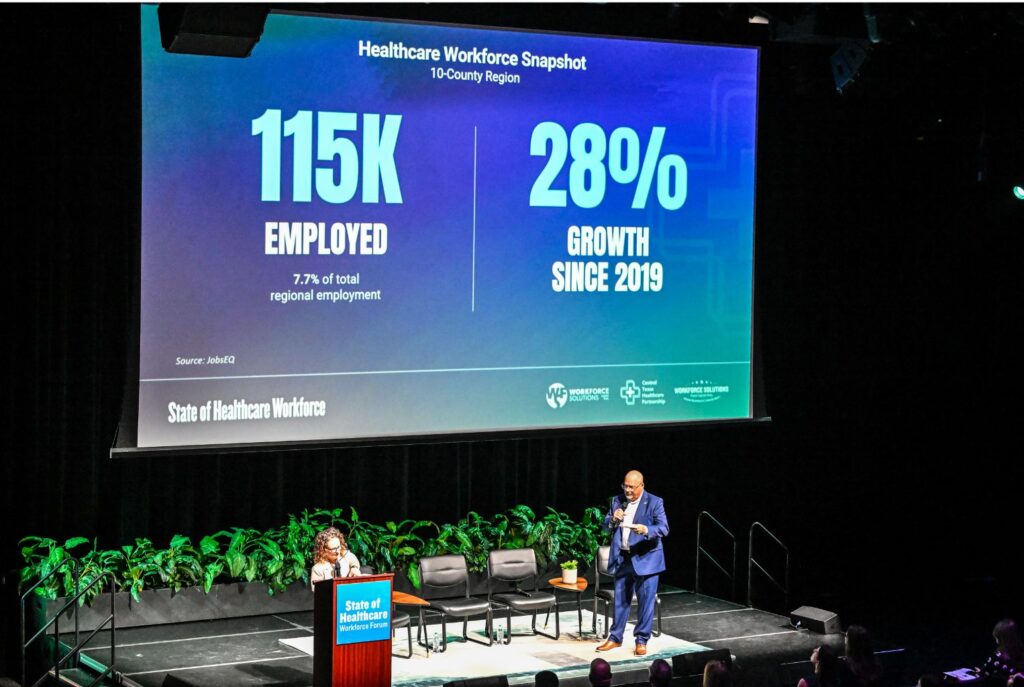
That same challenge surfaced in the regional workforce outlook. Workforce Solutions leaders noted that healthcare employment has grown 28% since 2019, with another 14,000 new jobs projected by 2031 before accounting for turnover. Roughly 1,800 RN and LVN openings are projected each year, while employers also need large numbers of medical assistants, nursing assistants and other entry-level workers.
The region has already made progress: collaboration among employers, educators and workforce partners has helped more than double the number of nursing graduates over the past five years.
Supporting the student means supporting the workforce
Another takeaway from the forum was that tuition alone does not determine whether someone completes healthcare training.
Working adults and first-generation students may be balancing housing costs, transportation, child care, food insecurity and lost wages while completing coursework and required clinical hours.
The impact of addressing those barriers is measurable. ACC reported that students receiving child care scholarships have an 81% persistence rate, compared with approximately 60% overall. Students using the college’s food pantry also persist at rates above the college average.
Capital IDEA Executive Director Alyssia Palacios-Woods, CFRE shared a similar whole-person approach. The organization currently supports approximately 1,000 students through tuition, fees, books, wraparound assistance and career navigation, with 85% pursuing healthcare careers.
These examples reinforce that transportation, child care, emergency assistance and career navigation are not separate from workforce development. They can determine whether an interested student ultimately becomes a qualified healthcare professional.
Creating more ways into — and through — healthcare careers
The forum also highlighted the importance of building career pathways that do not depend on a single entry point.
Healthcare apprenticeships have expanded earn-and-learn options beyond traditional skilled trades. Workforce Solutions leaders highlighted the region’s certified medical assistant apprenticeship as an especially popular model that has created jobs while allowing people to earn wages during training.
Regional partners are also working to create clearer pathways from entry-level healthcare occupations into higher-wage careers through stackable credentials and credit for prior learning.
And those pathways are starting earlier.
The Central Texas Healthcare Academy, developed by the Central Texas Healthcare Partnership, is designed so students can begin healthcare training while still in high school. Students will complete their pre-requisites and co-requisites for pathways including nursing, surgical tech, radiology tech, and health information technology.
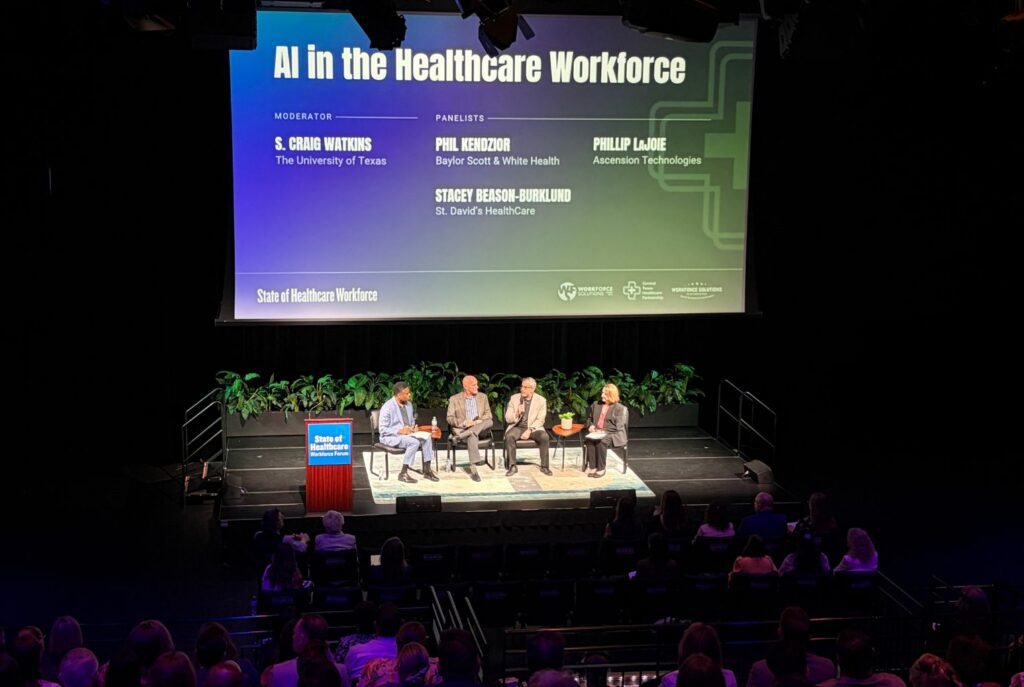
AI may change the work, without removing the human
The forum also looked ahead to how artificial intelligence could reshape healthcare work.
Panelists described AI tools already helping clinicians draft documentation, screen job applicants and manage administrative work. The common thread was less about replacing healthcare professionals and more about giving clinicians time back for patients, teams and higher-value work.
That transition will require new skills. Panelists emphasized AI literacy, understanding when to trust or verify a tool’s output, change management and strong human oversight. They also stressed that governance, privacy and transparency will be essential as AI becomes more integrated into healthcare settings.
The goal, as the panel described it, is augmentation rather than replacement: using technology to support clinical expertise, improve patient experience and help healthcare professionals spend more time doing the work that brought them into the field.
Proof that rural investment can work
Bastrop County Public Health Department Executive Director Donna Nichols offered a clear example of what these ideas look like in practice, particularly in rural communities.
Through the Create a Job, Save a Job initiative, funded by St. David’s Foundation, 170 Bastrop County residents enrolled in healthcare training during the program’s first year. 102 graduated and 77 secured employment, including EMTs, CNAs, phlebotomists, mental health counselors, RNs and LVNs — many in Bastrop County itself.
The program paired approximately $340,000 in tuition assistance with support for transportation, equipment, housing and other barriers. Its case-management approach was also identified as a key part of helping participants stay on track.
The example shows what can happen when identifying workforce demand is followed by building pathways and helping people successfully move through them.
The opportunity: scale what works
The forum did not point to one solution for Central Texas’ healthcare workforce challenge. It pointed to many: more clinical placements, expanded simulation capacity, apprenticeships, stronger K–12 pathways, stackable credentials, student supports, employer engagement and better coordination across institutions.
What connects those strategies is partnership.
As the forum closed, Workforce Solutions leaders emphasized that some of the region’s strongest progress has come from bringing employers that normally compete for talent to the same table with educators, community organizations and workforce partners to solve shared problems.
The Central Texas Healthcare Partnership is one way the region is putting that collaborative approach into practice.
The opportunity now is to take what is working and build it to scale — creating a stronger, more connected healthcare workforce system that can keep pace with the needs of a growing region.

Go deeper into the data
Two recently released resources provide additional context behind many of the workforce trends discussed at the forum.
Central Texas Healthcare Workforce Needs and Education Pipeline Study: A comprehensive look at healthcare workforce demand, employer needs, education capacity and county-level opportunities across the 10-county Central Texas region.
Texas Talent Experts: Healthcare Industry Snapshot: A quick-read look at six priority healthcare occupations, career pathways and examples of regional workforce collaboration.