Find a Job Now
Get support and connect with local employers.

Train for a New Career
Explore training for in-demand, stable careers.

Attend a Career Workshop
Build job-search skills through live workshops.

Attend Hiring Events
Meet employers hiring now.

Austin Infrastructure Academy
Careers in construction, transportation, and skilled trades.

Youth Services
Support for ages 14–24 to build skills, explore careers, and find work.

Veteran Services
Priority support and career services for veterans and their spouses.

Business Solutions
Hiring and training support tailored to your workforce goals.

Case Studies
See how local employers solve workforce challenges with us.

Host or Join Hiring Events
Connect directly with job seekers.

Major Events at a Glance
Explore upcoming workforce and industry events in the region.

Healthcare
Collaborating with industry leaders to grow the healthcare workforce.

Mobility & Infrastructure
Advancing talent pipelines for construction, transportation, and skilled trades.

Industry Reports & Insights
Labor market reports and insights to support workforce planning.

Labor Market Dashboard
Data on the regional labor force, employment, jobs, and wages.

Podcast
Conversations shaping Austin’s jobs, economy, and future.

For Parents
Access to affordable, high-quality child care and family support.

For Providers
Partnerships and resources to support quality child care programs.

Success Stories & Testimonials
Real stories from families and providers we support.

Category: Blog

  • Meet our new board member: Emily Gupton

    Meet our new board member: Emily Gupton

    We’re honored to welcome Emily Gupton to the Board of Directors at Workforce Solutions Capital Area (WFS).

    A seasoned entrepreneur, executive, and passionate community builder in Austin, Emily is passionate about empowering women and fostering a network to make Austin a hub of technology, innovation, and next-gen leadership. She currently serves as Chief Technology Officer at SKG.

    In Emily’s own words:

    “I’m committed to building a stronger local workforce because I believe equitable access to opportunities, learning, and building new skills will transform lives and strengthen our Austin community. My work as a woman in the C-suite, along with my engagement in the technology community, has shown me the transformations that result by connecting people with the resources they need to grow and thrive in the world today. I’m passionate about preparing people for the jobs of the future, and ensuring our workforce is skilled, inclusive, and prepared.

    I am honored to join the board of directors for WFS. I am excited to engage our local tech companies to understand what they need from a local talent pipeline, allowing WFS to develop impactful training programs, apprenticeship programs, scholarships, job search assistance, and more for the Austin community.”

    Grow your business through talent: Workforce Solutions is uniquely positioned to help employers of all industries directly connect with local job seekers and talent. We’re collaborative and can tailor services based on your company’s needs. Get started.

  • Central Texas Healthcare Partnership: Nursing Students Shine at 2025 Interprofessional Health Showcase

    Central Texas Healthcare Partnership: Nursing Students Shine at 2025 Interprofessional Health Showcase

    Students from The University of Texas at Austin School of Nursing made an impressive display at the 7th Annual Interprofessional Health Showcase, hosted by the Center for Health Interprofessional Practice and Education. Held in April 2025, the event brought together students from across health disciplines to present innovative, collaborative projects aimed at improving patient care, health systems and community well-being.

    This year, nursing students contributed to award-winning work across a range of categories, including quality improvement, community engagement, literature review and interprofessional projects.

    Go deeper.

  • Meet our new board member: Dr. Larry Wallace, Jr.

    Meet our new board member: Dr. Larry Wallace, Jr.

    We’re honored to welcome Dr. Larry Wallace Jr. to the Board of Directors at Workforce Solutions Capital Area.

    A veteran, former mayor, author, and longtime nonprofit leader, Dr. Wallace has shaped policy, championed community health, and built bridges across sectors throughout his career. He currently serves as Sr. Director of Operations at the Black Men’s Health Clinic and brings a perspective grounded in both leadership and lived experience.

    In his own words:

    “What drives my commitment to building a stronger local workforce is the lived reality that too many people fall through the cracks—not because they lack talent or work ethic, but because the system wasn’t designed with their path in mind.

    After retiring from the military, I experienced this firsthand. Despite years of leadership and service, my experience didn’t clearly align with traditional civilian roles, and I often found myself at the starting line all over again. The opportunities I’ve had since then weren’t part of some strategic career plan—they came from moments of chance, where people saw a need and believed I could meet it. Those moments shaped my path, and they’ve made me passionate about ensuring that workforce decisions reflect real, varied journeys—not just the traditional ones.

    That’s why I’m honored to join the Board of Workforce Solutions Capital Area. I believe we have a responsibility to build a system that doesn’t just replicate what worked for some, but reimagines what’s possible for all. When we do that, businesses don’t just meet their staffing needs—they tap into a deeper well of talent, creativity, and resilience that’s too often overlooked.”

    Grow your business through talent: Workforce Solutions is uniquely positioned to help employers of all industries directly connect with local job seekers and talent. We’re collaborative and can tailor services based on your company’s needs. Get started.

  • Central Texas Healthcare Partnership: Fairfield students honored with Flower Bud Awards

    Central Texas Healthcare Partnership: Fairfield students honored with Flower Bud Awards

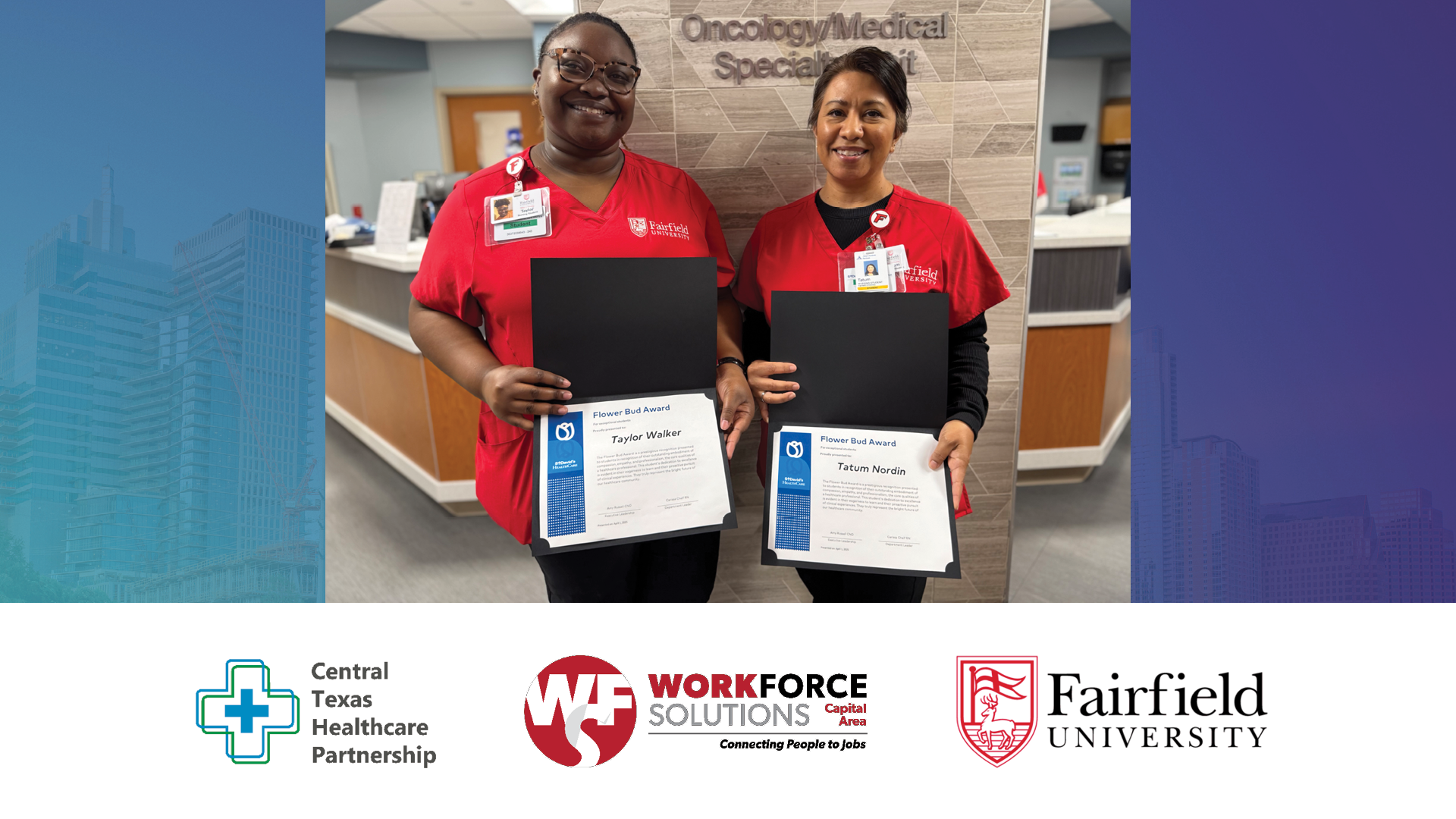
    Tatum Nordin and Taylor Walker, nursing students at Fairfield University’s Austin Campus, were honored by St. David’s North Austin Medical Center with Flower Bud Awards. The prestigious award recognizes exceptional students who embody the core qualities of compassion, empathy, and professionalism during their clinical rotations.

    Driving the news: Nordin and Walker are in their third semester of the Accelerated Second Degree Nursing program at the Marion Peckham Egan School of Nursing and Health Studies. They were assigned to St. David’s as part of their Medical-Surgical Nursing II course.

    What they’re saying: “The qualities for which Tatum and Taylor received recognition are fundamental to Fairfield’s Jesuit identity and the Egan School’s vision, mission, and purpose,” said Christina Trezza, MSN, RN, CNE, CCM, instructor of the practice and clinical coordinator in Austin. “It is no surprise that these exceptional students are turning heads with their outstanding and compassionate care for patients. I am so proud of them.”

    Why it matters: The Flower Bud Award draws inspiration from the DAISY Award, an international nomination-based award given to registered nurses who demonstrate extraordinary compassion and outstanding clinical skills. The DAISY Foundation recognizes the Flower Bud Award as a companion award for nursing students.

    Catch up quick: Nordin and Walker received their award certificates in a ceremony attended by several of their Fairfield classmates, the nurse manager, and the chief nursing officer at St. David’s. The two students were celebrated for their dedication to excellence, exemplified by their enthusiasm for learning and clinical experiences.

    “Nursing school is incredibly challenging, so this recognition is a sign that all my hard work is paying off,” said Walker. “I am genuinely grateful for the acknowledgement and support from St. David’s.”

    Modest and sincere, Walker was quick to recognize her friends and faculty at Egan Austin. “I would not be at this point without my classmates, clinical instructor, and nursing professors,” she said. “This award honestly belongs to everyone!”

    Texas State University is a member of the Central Texas Healthcare Partnership. The partnership was founded in early 2018 under the leadership of three Central Texas healthcare industry leaders: Baylor Scott & White Health, Ascension Seton, and St. David’s HealthCare. Learn more about how the CTHP is leading workforce development in the Central Texas healthcare industry.


  • Capital Area Retention and Elevation Program awards $1.2 million in bonuses to child care providers

    Capital Area Retention and Elevation Program awards $1.2 million in bonuses to child care providers

    We’re awarding $1.2 million in bonuses to our child care providers through our Capital Area Retention and Elevation (CARE) Program!

    Why it matters: CARE provides financial incentives to eligible early learning providers to support staff retention, motivation, and satisfaction. We want to recognize and reward providers’ dedication to high-quality childcare and strengthen the long-term well-being of families in our community.

    This year, we selected 51 providers with a total of 483 staff for awards, ranging from $1,000 to $3,000 per person, depending on how many people each provider employs. Providers can distribute bonus funds to their staff based on individual performance and contributions.

    What’s happening: These providers participate in Texas Rising Star, a quality rating and improvement system for Texas early childhood programs. All center based and home based child care providers in Texas can be certified in Texas Rising Star if they meet certain eligibility criteria. Programs that participate in Texas Rising Star meet higher quality standards than many other child care programs.

    Katelyn H.
    Katelyn H. is a director at a child care center in Austin.

    Katelyn H. is a director at a center caring for 67 children receiving scholarships. Her center has participated in Texas Rising Star for 10 years. 

    “This has helped teacher retention, especially when we cannot afford to give raises each year,” Katelyn said.

    Other providers shared how CARE impacts their Early Learning Programs: 

    “It has been such a blessing to my program. It has made such a positive impact to my center to have the extra assistance to provide more quality childcare to my children,” Tanya Joiner said.

    “This funding helps providers because the limited funding and the low enrollment we are not able to give raises to our staff do to limited funds. With this funding we are able to show appreciation as well as retain good teachers and directors,” Ramonica Williams said.

    “It allows us to hire with sign-on bonuses and allows to keep our current staff and show appreciation. This is very helpful for centers to show appreciation and support to their staff,” Alejandra Gardner said.

    Any licensed or registered provider of child care services in Austin/Travis County may apply to have a provider agreement with Workforce Solutions Capital Area Child Care Services. As part of our commitment to quality child care, Workforce Solutions Child Care Services offers quality rated programs, quality initiative activities and other community resources to child care providers who strive for quality. Learn more about how to participate.

  • Central Texas Healthcare Partnership: Blending pharmacy and nursing for maximum reach

    Central Texas Healthcare Partnership: Blending pharmacy and nursing for maximum reach

    Originally published on Vital Record on Feb. 25, 2025.

    Ali Moballegh, PharmD, BSN, RN, is a pharmacist and an Aggie nurse.

    Currently enrolled in the Texas A&M University College of Nursing’Master of Science in Nursing-Family Nurse Practitioner program, Moballegh is not changing his career—far from it. He currently works as a pharmacist for Baylor Scott & White’s outpatient pharmacy and hopes to enhance his practice with his nursing master’s degree.

    “I felt that I was underutilizing my pharmacy degree as a pharmacist only,” Moballegh said. “I want to use my knowledge as a pharmacist to be able to diagnose and prescribe. I want to expand and utilize my pharmacy degree and knowledge to the maximum.”

    After earning his Doctor of Pharmacy degree from the University of Houston in 2021, Moballegh returned to complete a Bachelor of Science in Nursing via its accelerated nursing program. He then moved to Georgetown, Texas, where he briefly worked as a medical-surgical nurse at Baylor Scott & White in Round Rock and discovered an interest in primary care. This inspired him to pursue the family nurse practitioner program at Texas A&M. Having only worked as a pharmacist up until that point, Moballegh also gained a newfound respect for the strenuous requirements of nurses.

    “You have to be completely selfless and sacrifice a lot for your patients,” Moballegh said. “While pharmacy is very stressful sometimes, it’s easier to have a balance between your life and your work. As a pharmacist, you need to memorize a lot of things. But as a nurse, you need to develop a lot of hands-on skills. I greatly appreciate what nurses do. They are angels, and not everybody can do the job.”

    Moballegh said that going through the MSN-Family Nurse Practitioner program—which is delivered online with some in-person clinical requirements—as a working pharmacist has been challenging. But it also comes with its advantages. While many nursing students find pharmacology to be one of the toughest courses, for Moballegh, it was simply the work does every day.

    Moballegh is still considering how his nursing journey will develop, but he has a vision for what his career might look like after he graduates in spring 2026. He plans to continue working as a pharmacist in the Austin area and begin working as a family nurse practitioner. He could even see himself returning to school to get his Doctor of Nursing Practice degree.

    A little further down the line, Moballegh hopes to use his nursing and pharmacy degrees under one roof in a practice of his own serving rural areas.

    “I’d love to start a local clinic that makes health care easily accessible for people who are underserved,” Moballegh said. “I’d include pharmacy services and provide treatment for non-serious issues like a sore throat. If people don’t have access or insurance and they cannot afford a copay, they just ignore things, and it can cause complications. if they have something affordable and accessible, we can prevent these complications.”

    Whatever is in the cards for Moballegh after graduation, he’s eager to expand his reach with MSN credentials in hand and believes becoming an Aggie nurse was the right choice.

    “I have enjoyed being a Texas A&M student,” Moballegh said. “It’s been the perfect fit and has made it possible for me to continue working full time while getting my master’s. I’ve loved the curriculum and the faculty. I’ve experienced many universities, but I think I can say Texas A&M is the best I’ve had.”

    Texas State University is a member of the Central Texas Healthcare Partnership. The partnership was founded in early 2018 under the leadership of three Central Texas healthcare industry leaders: Baylor Scott & White Health, Ascension Seton, and St. David’s HealthCare. Learn more about how the CTHP is leading workforce development in the Central Texas healthcare industry.
  • Workforce Innovation and Opportunity Act Local Workforce Development Board Plan Program Years 2025-2028

    Workforce Innovation and Opportunity Act Local Workforce Development Board Plan Program Years 2025-2028

    Under the Workforce Innovation and Opportunity Act (WIOA), local workforce development boards are required to develop a four-year strategic plan that identifies and describes policies, procedures, and local plans that align with the Texas Workforce Commission’s state plan.

    This is a compliance requirement under WIOA. All boards developed their plans, which were approved by Governor Greg Abbott.

    Our approved WIOA Strategic Plan for Program Years 2025-2028 with two-year modifications is now available for viewing.

    Click here to view the 2025-2028 WIOA Strategic Plan.

  • Central Texas Healthcare Partnership: Poverty Simulation with Texas State University

    Central Texas Healthcare Partnership: Poverty Simulation with Texas State University

    This month, over 110 nursing and radiation therapy students at Texas State University participated in a Poverty Simulation—an immersive experience designed to deepen empathy, understanding, and compassion for individuals facing economic hardship. Through the support of our incredible community volunteers and faculty, students stepped into the shoes of those navigating the challenges of poverty.

    This experience helps future healthcare professionals recognize the social determinants of health and reinforces the importance of delivering equitable, patient-centered care.

    “This opened my eyes to what many families face every day. I will carry this perspective into every patient interaction,” said one student participant.

    Texas State University is a member of the Central Texas Healthcare Partnership. The partnership was founded in early 2018 under the leadership of three Central Texas healthcare industry leaders: Baylor Scott & White Health, Ascension Seton, and St. David’s HealthCare. Learn more about how the CTHP is leading workforce development in the Central Texas healthcare industry.

  • Central Texas Healthcare Partnership: Filling a Texas-Sized Shortage of Nurses

    Central Texas Healthcare Partnership: Filling a Texas-Sized Shortage of Nurses

    This article originally appeared in Fairfield University Magazine, the alumni magazine of Fairfield University.

    Bryan Rivera ’25 was not born in Texas. But as the saying goes, he got here as fast as he could. It was a circuitous route, to be sure, as Rivera was born in Spain, raised in the Philippines, and schooled in Alaska. Today, he resides in Austin, Texas, and is a nursing major in Fairfield University’s Accelerated Second Degree Nursing (ASDNU) program.

    More than halfway through his bachelor of science in nursing (BSN) degree studies in the Marion Peckham Egan School of Nursing and Health Studies, Rivera takes classes at Fairfield Egan’s state-of-the-art Austin, Texas campus. With graduation on the horizon, he looks forward to improving the lives of his fellow Texans.

    “I enrolled in nursing school because I want to have an impact on my community,” said Rivera. “Fairfield’s nursing program, with its emphasis on compassionate care, will help me achieve that goal and become a competent and caring nurse who makes a difference.”

    Fairfield Egan opened its Austin campus and launched its ASDNU program there in the summer of 2023. The 15-month program is designed for non-nursing baccalaureate degree holders who wish to pursue a second bachelor’s degree in nursing. The University led with that program because it provides the quickest means of sending BSN-prepared nurses into the workforce.

    The ASDNU program was perfect for Rivera, who holds a bachelor of business administration degree in marketing and worked as an advocate for higher education for nearly a decade. After completing a few additional science prerequisites, he entered the program as a junior.

    “The program is a great opportunity for people like me who are interested in nursing but pursued a different path with their initial degree,” he said. “It also fills an important gap in nursing education in the area.”

    Austin is one of the fastest-growing cities in one of the fastest-growing states in the nation. Its unprecedented growth has transformed the once laid-back college town into a major metropolis. As with any city, population growth can strain resources. Such has been the case in Austin and the state of Texas, where the impact of domestic migration on the healthcare system has become especially obvious in recent years.

    The demand for nurses in Texas is driven largely by the same factors as in other areas — aging populations, educational bottlenecks, occupational burnout, and workforce retirement — but is further amplified by regional growth. The year-over-year increase in new residents has caused and continues to cause a Texas-sized shortage of nurses. In fact, the Texas Center for Nursing Workforce Studies projects a statewide deficit of more than 56,000 registered nurses by 2036.

    For Connecticut-based Fairfield, the nursing shortage in Texas provided the impetus for an Austin campus. There was an urgent need for qualified nurses in the state, and the Egan School is nationally recognized for its expertise in nursing education. Geographical expansion into the Southwest offered an extraordinary opportunity for the mission-driven Jesuit university to reach a wider audience and to impact the health of a community and its residents.

    Christopher Mangram ’25, a classmate of Rivera’s, is a native of Houston who traveled the world as a Navy corpsman. His experiences in the military compelled him to pursue a career in nursing. He discovered Fairfield Egan’s ASDNU program upon his return to Texas and immediately enrolled.

    “I realized my calling during a Navy deployment to Southeast Asia, where I was sent for humanitarian purposes,” Mangram said. “I mostly conducted health screenings but also delivered a baby in Timor-Leste and taught neonatal resuscitation to midwives in Malaysia.”

    Neither Mangram nor Rivera are typical nursing students. Both are male and have considerable life experience — two points that are not unrelated in nursing school. Greater life experience often means increased exposure to medical situations and awareness of the value of care providers. It can also make people less susceptible to stereotypical thinking about nurses and nursing.

    It is therefore not surprising that Mangram, Rivera, and their fellow male nursing students represent 19 percent of their Austin cohort. That impressive figure well exceeds the national average of 12.8 percent for men in undergraduate nursing programs.

    Because the ASDNU program is designed for non-traditional students, it tends to attract more diverse populations than traditional BSN programs. As such, it was the right program with which to launch the new Austin campus and to extend the University’s reach and impact.

    Fairfield University was not founded in Texas, but it got here as fast as it could.

    Fairfield University is a member of the Central Texas Healthcare Partnership. The partnership was founded in early 2018 under the leadership of three Central Texas healthcare industry leaders: Baylor Scott & White Health, Ascension Seton, and St. David’s HealthCare. Learn more about how the CTHP is leading workforce development in the Central Texas healthcare industry.

  • Central Texas Healthcare Partnership: Spotlight on Fairfield University

    Central Texas Healthcare Partnership: Spotlight on Fairfield University

    Workforce Solutions Capital Area partners with many local healthcare employers to train and hire the workforce for this key local industry. One of our partners is Fairfield University.

    Fairfield University’s nationally ranked nursing school expanded into Austin in 2023 with its accelerated second degree nursing program. Gabby Kearney is among the first graduates of the 15-month program at the state-of-the-art campus on Shoal Creek Boulevard.

    Gabby is currently an RN Resident in the Intermediate Care Unit at Dell Children’s Medical Center. She was offered the position after completing Ascension’s Student Nurse Intern Program there in her final semester at Fairfield.

    She is delighted to share her experiences below.

    How did your intern experience prepare you for your current position?

    The Student Nurse Intern Program was an invaluable experience! I am so much farther ahead than other members of my cohort who didn’t have the same opportunity, and it has given me so much more confidence as a newly graduated nurse.

    I have been able to take over full patient loads in my first 6 weeks of my orientation with minimal intervention from my preceptors because I have already had five months of experience on the unit and with my coworkers. The extra time on the unit has allowed me to build relationships with my coworkers and demonstrate my competencies that I have learned in nursing school and while on the unit during the SNI experience.

    Building these relationships has allowed my coworkers to have more trust in me taking over care for their patients. By having a head start, I have been scheduled for more shifts in the Pediatric Intensive Care Unit and received exposure to higher acuity patients coming to our floor once they have stabilized. I would not have felt comfortable being in the PICU if I didn’t have the extra experience from SNI.

    What aspects of your Fairfield education were most valuable?

    I appreciate the diligence of my professors at Fairfield. They prepared me to be successful by regularly testing my critical thinking skills, which are the hardest skills to become proficient in as a new nurse. They also taught me how comorbidities of real life patients intertwine and complicate the basic pathophysiology taught in the textbook cases.

    Most importantly, my professors taught me to always ask questions when something is not clear or doesn’t make sense, to advocate for my patients, and to never stop learning new information.

    Fairfield University is a member of the Central Texas Healthcare Partnership. The partnership was founded in early 2018 under the leadership of three Central Texas healthcare industry leaders: Baylor Scott & White Health, Ascension Seton, and St. David’s HealthCare. Learn more about how the CTHP is leading workforce development in the Central Texas healthcare industry.